I have been meaning to go to Mr Cad for a very long time.
Years, if I’m honest.
It’s one of those places that comes up again and again when you start shooting film. Somebody mentions it in a forum. Somebody else has a story about the lens they found there. A friend of a friend picked up a camera for next to nothing and it still works beautifully. And every time, I’d think, I must go.
And then I didn’t.
Life, as it does, got in the way. London always felt like a big day out rather than a quick hop, and there was always a reason to leave it for another time.
So when I finally walked down Upper Tachbrook Street in Pimlico and saw the shop, I’ll admit I had a little moment.
I’m not sure what I was expecting.
Something grander, maybe. Something with a bit more fanfare.
Instead it’s a fairly modest shopfront on an ordinary London street, near enough to Victoria station that you could quite easily walk straight past it on your way somewhere else.
Please don’t.
Because inside, it is wonderful.
Every shelf, every cabinet, every corner is full. Lenses stacked in trays like sweets in a pick and mix. Tripods leaning against each other. Boxes of accessories you’d forgotten existed. Camera bodies lined up in glass cabinets that go almost to the ceiling. It is the kind of shop where you go in for a roll of film and come out an hour later having had three conversations, learned something new and talked yourself out of buying something you absolutely did not need.
Mostly talked yourself out of it.
The story of Mr Cad is part of what makes it so special. It was started by Alex Falk, who opened his first camera shop in Croydon back around the turn of the 1960s. Over the decades it grew and grew, and for a long time the Croydon warehouse was one of the biggest suppliers of used cameras anywhere in Europe. Professionals, students, schools, keen amateurs, people like me with more enthusiasm than technical knowledge. Everyone went to Mr Cad.
Then, as film fell out of fashion and everybody switched to digital, the world changed around it.
In 2013, after more than fifty years, the Croydon warehouse closed, and everything that was left moved into the much smaller shop in Pimlico.
Which explains a lot.
Because it does feel a bit like fifty years of camera history has been very lovingly squeezed into a space that was never designed to hold it all.
And from everything I’ve read, Alex Falk is still there, well into his eighties, still behind the counter. Not because he needs to be, but because he wants to be. And in fact as we walked in he welcomed us, chatted to us for almost half an hour, whilst simultaneously ensuring the other members of staff were noticing they needed to go and get some lunch.
I find that incredibly moving.
There’s something about people who have spent their whole lives doing one thing, and still love it. You can feel it in a place. It isn’t polished and it isn’t trying to be a lifestyle brand. It’s a camera shop, run by people who know cameras, for people who want to use them.
I took my camera in with me, of course.
I couldn’t not.
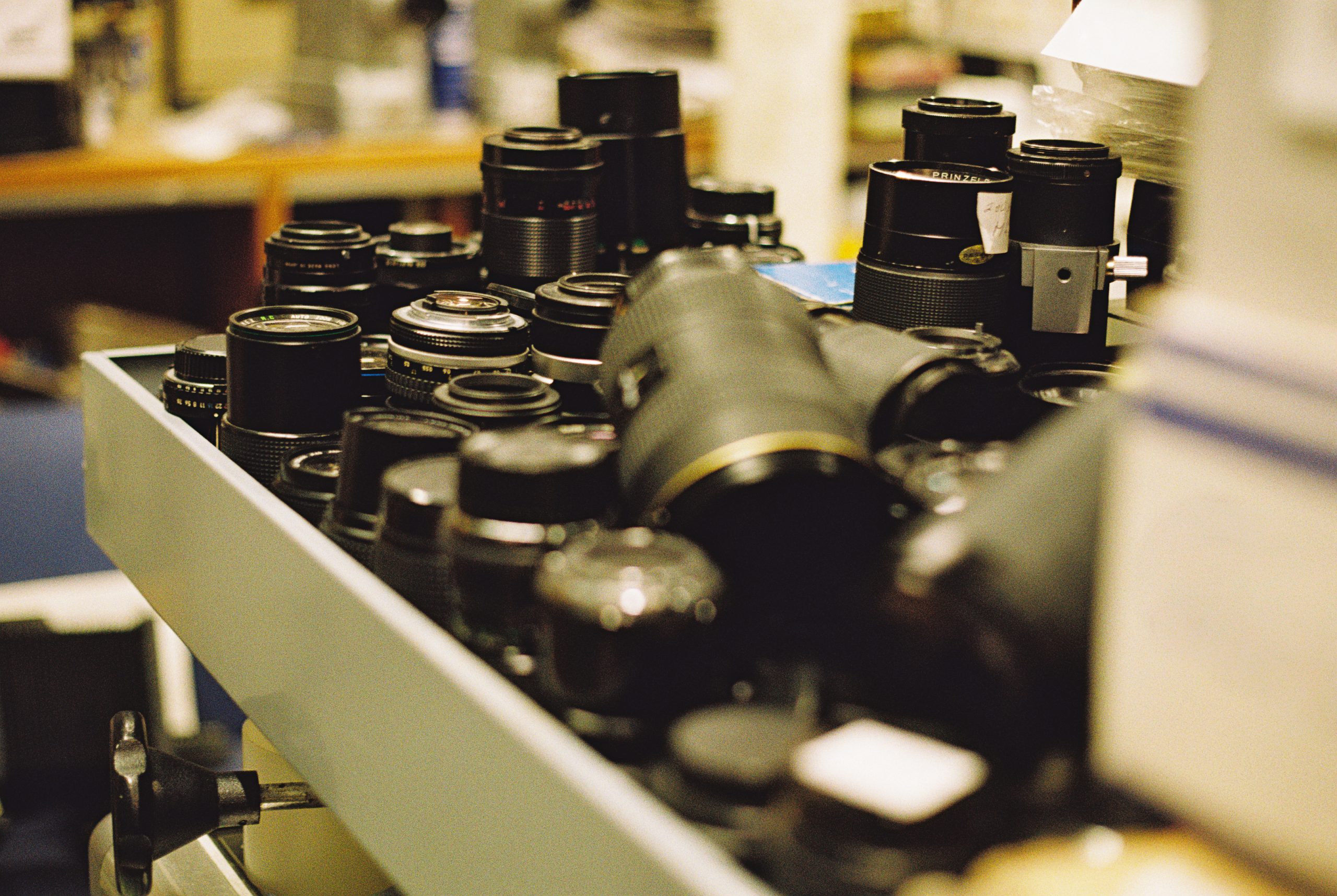
The first photograph is a tray of lenses. Dozens of them, all different ages, all different makes, all waiting for somebody to pick them up and give them a second life. Any one of them on sale for £20. I love the way the light catches the glass and the way they all seem to be jostling for attention. Every one of those lenses has already taken thousands of photographs. Holidays, weddings, children growing up, ordinary Tuesday afternoons. And they’re sitting there, quite patiently, ready to do it all again.
That feels like such a lovely thought.
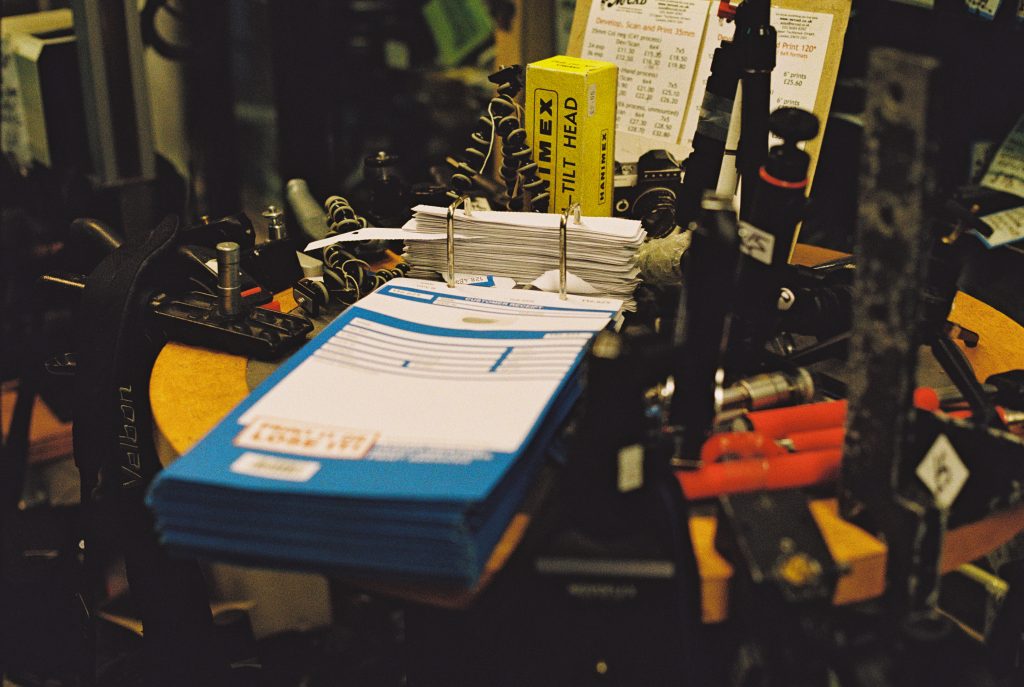
The second photograph is the counter. Film developing envelopes ready for the next person to come along and hand over a treasured roll of film. . A little yellow box for a tilt head. A tangle of bendy tripods. A price list for developing and scanning propped up at the back. It’s a bit chaotic, a bit cluttered, and completely real. It’s the bit of the shop where the actual business happens. Somebody bringing in a roll of film. Somebody collecting a repair. Somebody handing over a camera that belonged to their dad and asking if it still works and can they sell it.
I may have stood looking at that counter for slightly longer than was normal.
Nobody seemed to mind.
I think that’s what I loved most about Mr Cad. It doesn’t rush you. It doesn’t feel like a shop that’s trying to process you through a till as quickly as possible. It feels like a place where photography still matters, and where the slow, patient, slightly unpredictable business of shooting film is understood.
Which is exactly why I love it too.
So many of us have come back to film over the last few years. Some for nostalgia, some for the look, some because we were tired of taking four hundred photos on our phones and never looking at any of them again. For me it was something to do with slowing down and paying attention. Thirty-six frames. No screen on the back. A week’s wait to find out whether any of it worked.
Shops like Mr Cad are a big part of why that’s still possible.
Without them, all those cameras and lenses would be sitting in lofts and drawers, or worse, thrown away. Instead they’re out in the world, being used, being loved, being handed on.
We didnt really come our for anything though Bruce did end up buying some cartridge for bulk loading film whilst I looked at completely manual cameras that I could never begin to use but loved being able to hold.
It took me years to get there.
I don’t think it will take me as long to go back.